


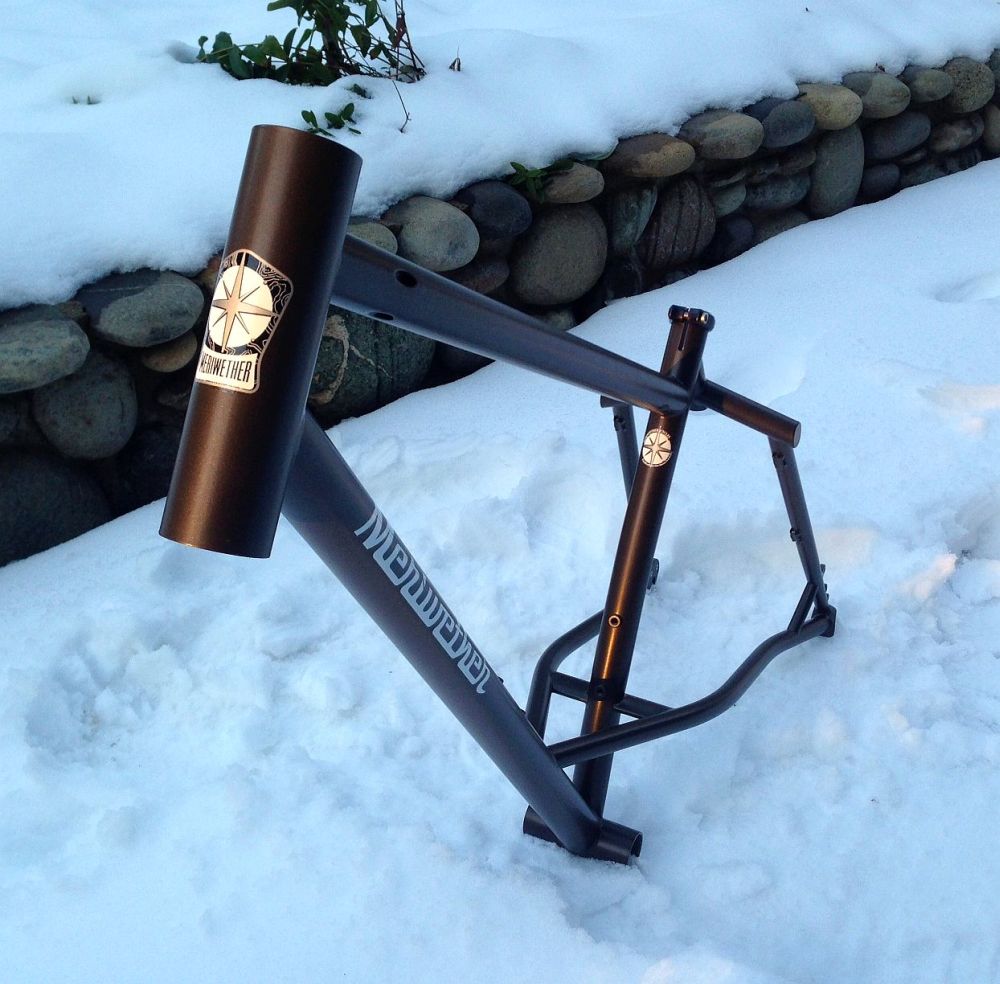


This is my 4th fatbike build. I’m still riding the first one but it got a nice facelift (black frame below). The latest frame is a much nicer version of my 2nd fatbike that also had elevated chainstays. Generally that was a “prototype” frame created to test some stuff for a friend (along with testing my framebuilding abilities at the time). That frame fit Big Fat Larry’s on Clown Shoe rims and had the same basic geometry as the Surly Moonlander (brown bike below).


The newest frame’s design was inspired by the many old MTB elevated chainstay bikes, but also because for fatbikes it makes even more sense. Especially with 4.8″ tires on 100mm rims, there is very little room between the chainring and the chainstay when you give the precious little room for tire clearance. Shorten the chainstays a bunch and it gets even harder. The Surly Moonlander is offset in the driveside direction by 28mm to accommodate the need for a better chainline and increased tire and chainring clearance. E-stays has been done before on fatbikes (i.e., 3D Racing, Minneapolis Bike Company’s “Murphy”) so it’s nothing new. Nnothing ever is with bikes these days.
This fatbike’s geometry was inspired by a conversation with Mike Curiak who likes his fatbikes to have similar geometry to his “all-mountain” MTB rigs – short chainstays and slack head tubes. This usually translates into long front centers and a bike that’s not great at slow speeds or climbing hills (wheel flop from lots of trail). I’m paraphrasing and expanding on what he said, but Mike argues that the traditional geometry model doesn’t fit the fatbike world with its low pressure fat tires, especially while on variable and soft ground. Having a slower steering rate (from the slack head tube angle) and a long front center makes it more stable even at slow speeds especially when there’s soft snow for the front wheel to plow through. You don’t swerve as much while trying to hold your line as you do with steeper headtube angled frames. The short chainstays provide increased traction and float better with the riders weight more on top of the rear axle. In addition to the slack head tube angle, having a greater % of your weight over the rear wheel also helps reduce the slow speed twitchy steering from any slight movement of the bars and that stops the wheel to from diving one way or the other because of reduced traction while riding on snow. I’ll see how these theories play out when I get to riding the new bike but I trust Mike when speaking on fatbikes since he’s been riding them longer than most and with many more geometries than others. My previous fatbikes have had much different geometry with 69.5, 70, & 70.5 degree head tube angles, and regular chainstay length for fatties (447 for the black one, 467 for the Moonlander e-stay, 450 for the newer orange one). I’m pretty “sold” on the slack head tube theory but not yet with the short chainstay part. Mainly because I think of it in terms of a ski – longer skis float better in snow than shorter skis. So a longer wheelbase bike should (in my mind) offer better floatation and more stability — a Cadillac versus a Jeep. I’ll update with any thoughts of course later once I get to riding it more.
This frame has a 68 degree head tube angle, 72 effective seat tube angle, 24.5″ top tube, 715mm front center, and a 45″ wheelbase (sorry for not sticking with the same units). You’ll likely notice the head tube, it’s a rather long 170mm since I like having my bars level with my saddle using as few headset spacers as I can. The fork is also mine with a 450 axle to crown and 50mm of offset giving the bike 100mm of trail (93 of mech. trail). Even though it looks like more, it’s got 6cm of BB drop for a BB height of just over 12.6″ using the Bud/Lou tire combo (without accounting for the sag from low tire pressure). For parts, it’s built up with a XT clutch rear derailleur, a 26t ring on 170mm crankarm Surly O.D cranks, and a 10-spd XT 11×36 cogset. If a SRAM X9 would fit without the crankarms hitting the chainstays I’d have chosen that for more gearing options using Wolf Tooth rings. The front wheel is a Clown Shoe with a Fatback 135 hub and the rear wheel has a 190mm Borealis hub. I made the stem – 90mm with 8 degree rise and it’s clamped to a Watson Ti “Revelation” bar.
For those interested in some fabrication details, i used a 38 x 1/0.7/1 True Temper Supertherm for the downtube with the longer butt on the bottom bracket side. That way, it stiffens up the less-supported BB and also let me weld the e-stays to the thicker wall of the tube. I supported the e-stays at the bent seat tube (31.8 x 0.035″) with a piece of streamline 4130 (1.18 x 0.5″, 0.035 wall). This should provide superior stiffness and strength than a plate but that’s just my take on it. The 3/4″ x 0.035 4130 chainstays were s-bent by me and mitered like seatstays to attach to the downtube (definitely had to spend some time on that one). The hooded Paragon dropouts were key in allowing a higher placement of the chainstays on the hood but getting the derailleur hanger at the right angle according to Shimano’s specs. I made a wishbone seatstay to get the huge tire clearance as my current tube bending mandrel isn’t tight enough in radius to get that much bend so soon before the seat tube (I have a 9.375″ mandrel and think you’d need at most a 7″ if not a 5″). I routed the two cables (rear brake and derailleur) through the top tube and externally from there to the rear dropouts.
The color is a bronze powdercoat to match the root beer colored Clown Shoe rims. It has little silver specks but without sun they don’t sparkle. The rear rack will hold my skis and a Jandd trunk pack while I hunt for turns. Just need some snow!


